Case Studies
The biggest loyalty program successes
Six programs that genuinely changed their businesses — what each one actually did, the numbers behind it, and the part a café, salon or bike shop can copy on Monday.
Why look at giants at all
Tesco spent years and a great deal of money learning things that now cost you nothing to know. None of these programs are copyable at your scale — but the reason each one worked almost always is, because it comes down to a decision about the offer, not the budget. Each section below ends with the transferable part.
Tesco Clubcard — the one that started it
Tesco launched Clubcard on 13 February 1995, after a 1994 trial analysed by a tiny consultancy called dunnhumby. The trial was small, and the finding was simple: customers who were rewarded came back more often and spent more. What sold the board was not the sales lift but what the data showed about who those customers were. Chairman Lord MacLaurin's reaction has been quoted ever since:
What scares me about this is that you know more about my customers after three months than I know after 30 years.Lord MacLaurin, then chairman of Tesco
Tesco printed sixteen million cards for the launch. Within a few years it had overtaken Sainsbury's to become the UK's largest retailer; the scheme had around 14 million active cardholders by 2009–10 and more than 20 million members by 2021. It was also expensive — the giveaway was reported to have cost Tesco around £1 billion in margin by 2003 — and it was still the best money the company spent that decade, because it bought a picture of its customers nobody else in the sector had.
The transferable part
The reward buys the visit; the record of who visited is what you keep. A paper punch card cannot tell you that your Tuesday regulars stopped coming in April. Any digital program can, and that information is usually worth more than the free coffee cost you.
Starbucks Rewards — loyalty welded to the payment
Starbucks' program is the most-cited loyalty success in the world for one reason: the numbers are enormous and the company publishes them. It reported 34.6 million 90-day active US members in its first quarter of fiscal 2025, and told investors that Rewards members drove close to 60% of US company-operated revenue across the year.
The mechanism matters more than the scale. Starbucks did not build a loyalty program that sits beside the transaction — it built one the customer uses to pay. Ordering, paying, earning and redeeming are the same three taps, so there is no moment where someone has to remember to produce a card.
The transferable part
Every second of friction between "I am paying" and "I am stamped" costs you signups. A card in Apple or Google Wallet is the small-business version of the same idea: nothing to install, nothing to remember, and it is already on the phone that is out of the customer's pocket at the counter.
Sephora Beauty Insider — tiers, and things money cannot buy
Beauty Insider launched in 2007 and has grown to roughly 45 million members in North America. Its structure is three tiers — free to join, then VIB and Rouge, reached by annual spend — but the widely studied part is what sits inside the tiers: early access to products, birthday gifts, in-store events, community. The program is routinely credited by loyalty analysts with driving around 80% of Sephora's annual sales, though that figure circulates through industry write-ups rather than Sephora's own disclosures, so treat it as indicative rather than audited.
What is not in doubt is the design choice. Sephora competes with every discounter online and chose to reward with access and status rather than with price.
The transferable part
Some of your best rewards cost you almost nothing: first pick of a new release, a seat at a tasting, the regular's usual table held on a Friday. A discount trains people to wait for discounts; a privilege does not.
Amazon Prime — the program people pay to join
Prime is loyalty inverted: instead of the business paying the customer to come back, the customer pays up front and then behaves as though every visit is free. Independent survey work by Consumer Intelligence Research Partners has consistently found US Prime members spending around twice what non-members spend — roughly $1,170 a year against $570 in their 2024 figures — and shopping considerably more often.
Some of that is selection: heavy shoppers join. But the sunk-cost effect is real and well documented across paid memberships — having paid for the privilege, people use it to justify the payment.
The transferable part
Paid loyalty works at small scale too, and often better: a $60 annual "coffee club", a prepaid ten-pack of classes, a membership that includes a free monthly treatment. You get the cash up front and a customer with a reason to choose you over the place next door.
Flybuys and Everyday Rewards — the Australian default
Australia is one of the most loyalty-saturated markets on earth. Coles' Flybuys and Woolworths' Everyday Rewards each count more than nine million active members in a country of about 27 million people, and The Point of Loyalty's annual research puts membership of at least one program at 93% of Australian consumers.
The same research contains the warning. Prompted with a list of programs, the average member says they belong to around ten — and only about half say they are active in all of them. Belonging is nearly universal. Attention is not.
The transferable part
You are not competing for a slot in someone's wallet; they have ten already and ignore half. You are competing to be one of the few that is genuinely easy and genuinely worth it. Small businesses win that contest on speed and warmth, not on points maths — the supermarkets will always beat you on points maths.
Mecca Beauty Loop — the Australian one worth studying closely
Mecca's Beauty Loop reached about 2.9 million members by 2025, which in Australian terms is remarkable for a specialty retailer. The engine is the Beauty Loop Box: a quarterly box of deluxe samples that members collect in store, with the contents getting better at higher tiers. Higher tiers also get priority access to events.
Two things are happening at once. The box requires a trip to a store, where people buy things. And it gets photographed — unboxing videos on TikTok and Instagram are a substantial free marketing channel that exists because the reward is a physical object worth showing off.
The transferable part
Make the reward collectable in person, and make it something a person would photograph. "10% off your next visit" is invisible. A small bag of single-origin beans handed over with a bit of ceremony is a reward, a return visit and a social post in one.
The instructive failures
Successful programs are mostly built out of mistakes other people made first. Two patterns repeat.
Moving the goalposts on people already playing
In September 2023 Delta rewrote SkyMiles so status depended almost entirely on spend. The backlash was severe enough that rival airlines publicly offered to match the status of defectors, chief executive Ed Bastian admitted the airline "probably went too far", and Delta rolled back part of the change within weeks. Starbucks, Dunkin' and Best Buy have all taken versions of the same hit.
Rewards nobody can be bothered to claim
Points that expire, rewards buried behind conditions, thresholds that take two years to reach. Members stop trying long before they formally leave; the program keeps reporting enrolment growth while doing nothing at all. Enrolment is the metric that hides the problem.
The two rules that follow
- If you change the deal, honour the cards already in circulation and tell people before it happens.
- Watch redemptions, not signups. A rising pile of unclaimed rewards is a program quietly failing.
What the six have in common
Strip away the scale and the same short list is underneath all of them:
- The reward is worth having, and everyone can say what it is in one sentence.
- Joining and earning take no effort at the moment of payment.
- Progress is visible — members can see how close they are without asking anyone.
- The terms hold still. Nobody is punished for having joined early.
- The business learns something it can act on from who is coming and who has stopped.
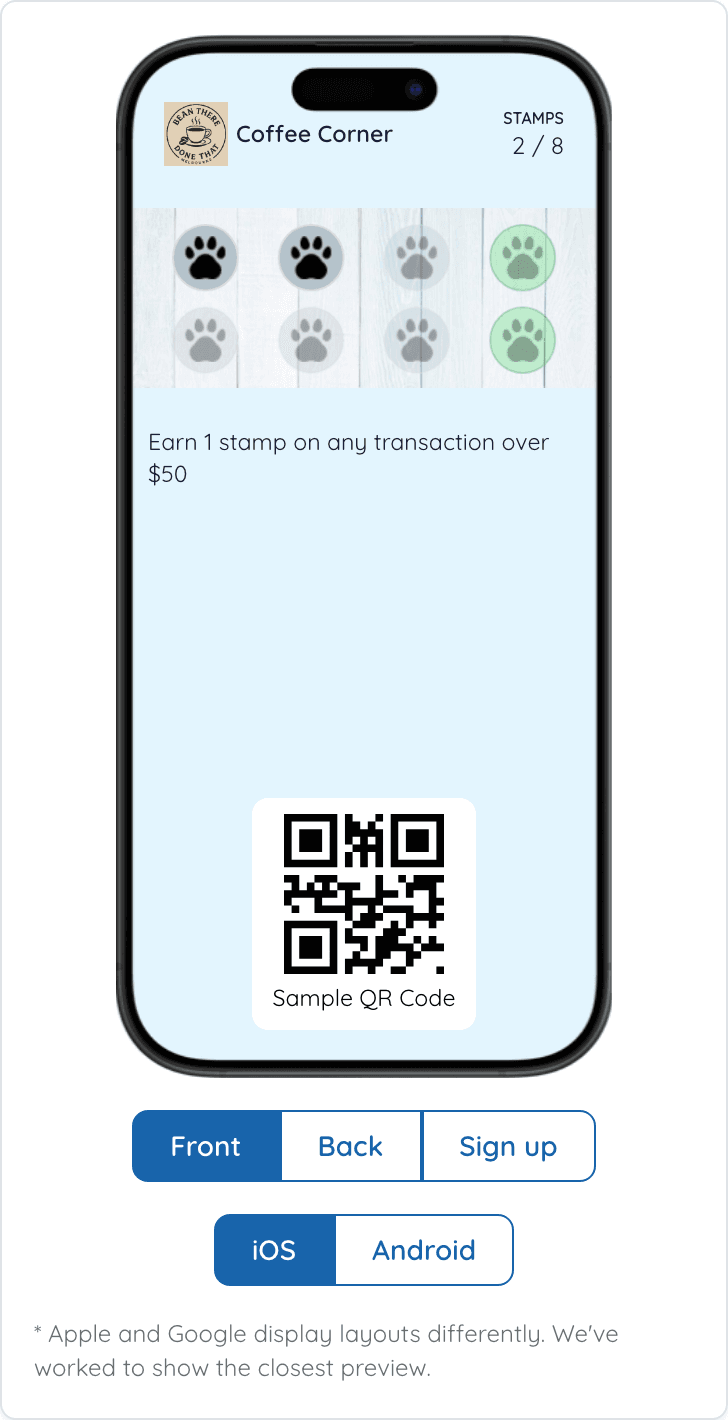
A digital stamp card does all five at a scale of one shop. The customer sees their stamp count in the wallet app they already have, staff add stamps by scanning, and you get the list of who is coming back.
Sources
Starbucks — Q1 FY2025 results (SEC filing)
Where the 34.6 million 90-day active US Rewards members figure comes from, in Starbucks’ own filing.
The 1995 launch, dunnhumby, the MacLaurin quote, and membership numbers over the following decades.
Consumer Intelligence Research Partners — Amazon Prime spending
The independent survey work behind the roughly two-to-one Prime versus non-Prime spending gap.
The Point of Loyalty — For Love or Money™
Annual Australian research on how members actually use the programs they belong to. Free executive summary.
CNN — Delta backtracks on SkyMiles changes after backlash
What happens when a loyalty program moves the goalposts on the people already playing.
Membership figures for Sephora, Mecca, Flybuys and Everyday Rewards are as reported publicly by those businesses and by loyalty industry research during 2025, and move around; the orders of magnitude are what matter here. Where a widely repeated figure is not published by the company itself, we have said so.