Best Practices
What makes a successful loyalty program
Most loyalty cards fail quietly: people join, never fill one, and forget. The handful of things that separate a card people finish from a card people forget are well understood, and none of them are complicated.
The one thing a loyalty program is for
A loyalty program has exactly one job: to make the next visit more likely than it would otherwise have been. Not signups, not points issued, not app installs. The next visit.
That is worth being blunt about, because almost every way a program goes wrong is a way of optimising for something else. A card that collects 400 email addresses and produces no extra visits has cost you money and taught you nothing.
About the statistic you have probably seen
"A 5% increase in retention increases profits by 25–95%" is the most quoted line in loyalty marketing. It traces back to Frederick Reichheld and Earl Sasser's 1990 Harvard Business Review paper Zero Defections — where the actual finding was that cutting defections by 5% raised profits 85% in one bank's branch network, with different figures in other industries.
The direction is real and well evidenced: repeat customers are worth disproportionately more than their visit count suggests, because you are not paying to acquire them again. The precise number is not a law of nature, and anyone quoting it at you as one has not read the paper.
Make the goal close enough to chase
This is the part the research is clearest about, and the part most programs get wrong.
People speed up as they get closer
Kivetz, Urminsky and Zheng followed café customers on a "buy 10, get one free" card. The gap between visits got shorter as the card filled: a customer holding eight stamps came back sooner than the same people had when they held three. After claiming the reward, the gap stretched out again. Progress itself is the motivator.
A head start counts, even when it is free
Nunes and Drèze gave car-wash customers one of two cards: eight blank squares, or ten squares with two already stamped. Identical work either way. The pre-stamped card was completed by 34% of customers, the blank one by 19% — nearly double, for a difference that exists only on paper.
What to do with that
- Set the stamp count against how often people actually visit. A daily coffee customer finishes ten stamps in a fortnight. A salon client who comes every six weeks would need more than a year — they will never see the reward, so the card does nothing for them. Match the goal to a month or two of normal behaviour.
- Stamp them on the spot when they join. One stamp at signup is the head start, and it costs you nothing you were not already giving away.
- Consider a reward on the way to the big one. Keeperoo lets you add several rewards at different stamp counts on the same card — something small at five, the real one at ten — so there is always a near goal as well as a far one.
One sentence, repeatable by a tired staff member
The most common reason people give for dropping out of a loyalty program is that earning the reward takes too long — and the second is that they never really understood how it worked. Both are solved by the same thing: a rule short enough to say out loud while handing over a coffee.
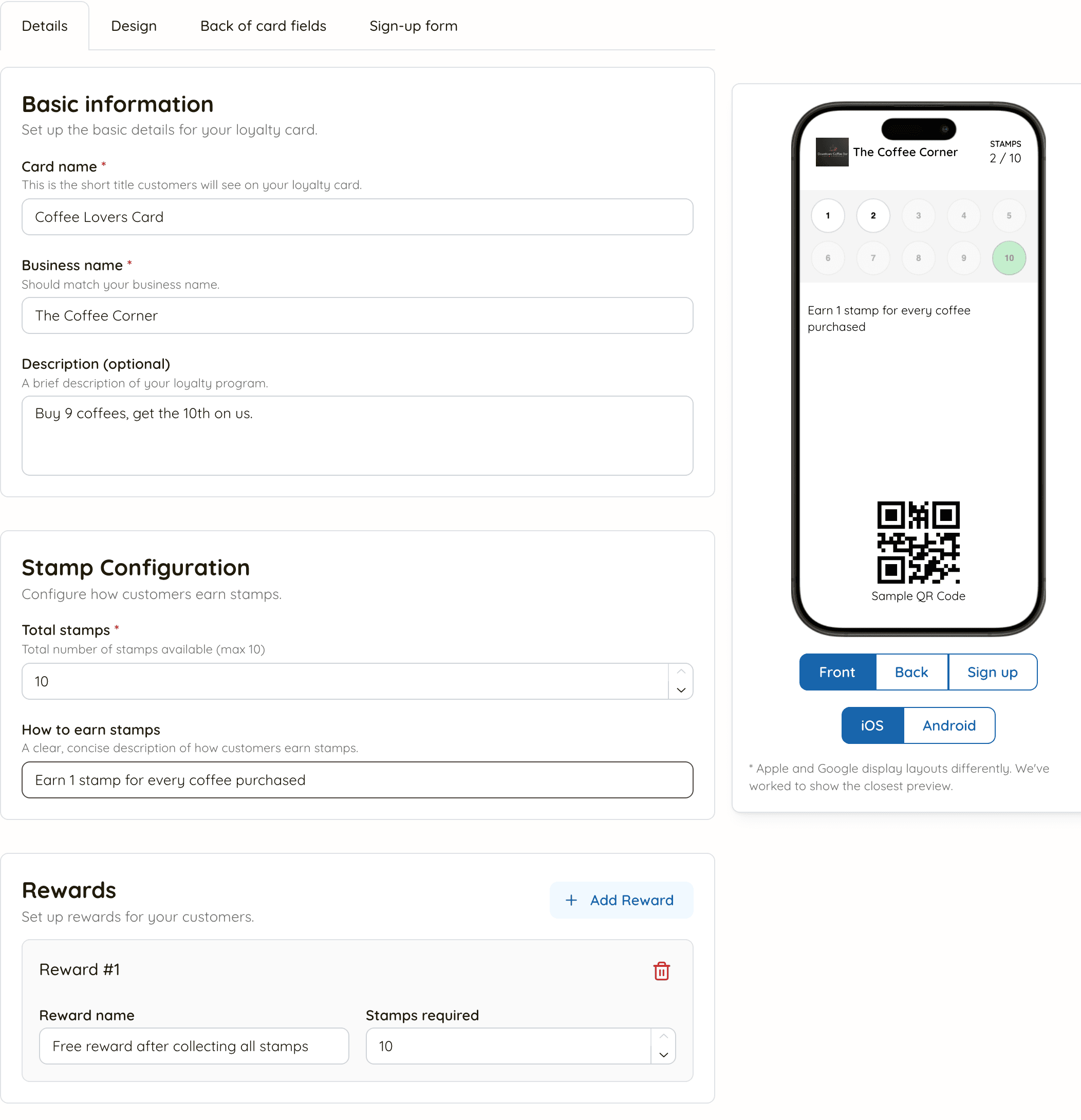
Buy 9 coffees, get the 10th on us.
That sentence goes in the How to earn stamps field, and it is printed on the card itself in the customer's wallet. If you cannot write your program that way, it is too complicated — not for you, for the eighteen-year-old on a Saturday shift who has to explain it forty times.
Complications that quietly kill cards
- Rules with exceptions — "stamps on coffee but not on the beans, and not with a voucher"
- Spend thresholds that need mental arithmetic at the counter
- Rewards that expire in a way the customer finds out about only when they try to claim
- Different rules at different locations
Price the reward before you promise it
A loyalty card is a discount with conditions attached. Work out the discount before you print anything.
The whole calculation
Cost of the reward ÷ (stamps required × average spend) = your effective discount.
A $5.50 coffee given free after ten visits at $5.50 each is a 10% discount — but the number that matters is your cost, not your price. If that coffee costs you $1.20 in beans, milk and cup, the real figure is $1.20 ÷ $55, or about 2%. That is cheap for a reason to come back.
Run the same sum on a reward you were tempted by — a free haircut after five, say — and it often lands somewhere north of 15%, which is a different decision entirely.
Two rules of thumb that follow from the arithmetic:
- Reward the thing with the best margin, not the most expensive thing on your menu. A free coffee costs a café far less than a free lunch and is wanted just as much.
- Do not be stingy either. A reward worth less than about one visit's spend reads as an insult by the time someone has earned it. The reward has to feel like the point of the exercise, because it is.
Somebody has to ask
This is the least interesting item on the list and by far the largest. Programs do not fail because the reward was wrong by 3%; they fail because on a busy Thursday nobody mentioned the card.
- Every staff member should have the card on their own phone. Showing beats explaining, and they cannot answer questions about a thing they have never seen.
- Agree the exact sentence. Not a policy — a sentence. "Have you got our card? Scan that and I'll stamp you now."
- Make asking the default, not the exception. The question gets asked at every transaction or it decays to none within a month.
The promotion guide covers where to put the QR code and what to say in more detail.
A reward that is never claimed is a failure, not a saving
It is tempting to treat unredeemed rewards as free money. They are the opposite. Across retail loyalty programs, redemption rates commonly sit somewhere between 20% and 50%, and practitioners treat a rate far below that as the clearest single signal that a program is not working — the reward is too distant, too fiddly to claim, or was forgotten.
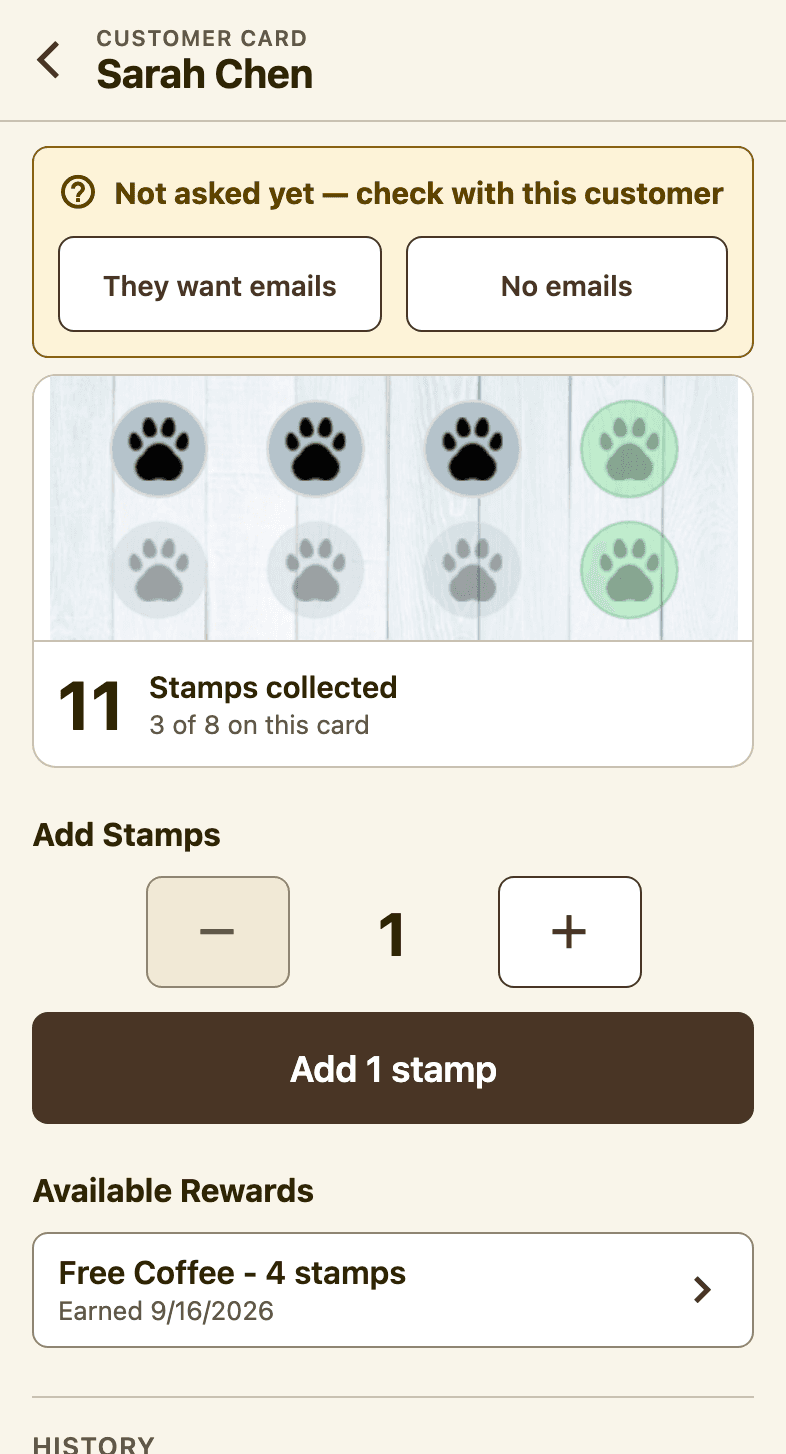
A customer who has earned something and not collected it is also the easiest win-back you will ever get: they already like you, and you owe them a free coffee. Scanaroo shows any available reward on the customer's card at the till, so staff can offer it without being asked.
Never devalue the deal
Changing a loyalty program in the customer's disfavour does more damage than never having run one. Delta's 2023 overhaul of SkyMiles is the textbook case: the changes made elite status much harder to reach, the reaction was severe enough that competitors openly courted its best customers, and the CEO conceded the airline "probably went too far" before rolling parts of it back. Starbucks, Dunkin' and Best Buy have each taken the same kind of hit after reworking earn rates.
At your scale the equivalent is smaller and just as costly: quietly raising the stamps needed, or telling a regular their stamps have expired. If you must change something, honour the cards already in circulation and say what you are doing before you do it.
The ACCC has views on this
The ACCC's 2019 review of customer loyalty schemes found members routinely surprised by changes to terms, by expiry rules, and by how their data was being used, and recommended clearer disclosure on all three. The report is aimed at supermarket and airline schemes, but the principle scales down: the terms a customer agreed to are the terms you are running.
The data is half the value
The stamps get customers back. The list of who they are is what you still have in two years. A paper punch card tells you nothing; a digital one tells you who comes weekly, who has drifted to once a quarter, and who joined in March and never returned.
- Collect only the fields you will actually use — every extra box costs you signups
- Ask for marketing consent properly at signup, in wording a customer would recognise as a request to email them
- Keep the list somewhere you can export it from, so it is yours and not your software's
Marketing consent covers the legal side, and exporting your customer list covers getting the data out.
How to tell whether it is working
Total signups is a vanity metric; it only ever goes up. These four say something:
Active customers in the last 30 days
On your dashboard. The headline number — people who actually earned a stamp, not people on a list.
The activity spread
How your members split across stamped in the last 7 days, 8–30 days, 31–90 days, over 90 days, and never stamped. A healthy program moves people up this ladder month by month.
Rewards redeemed versus rewards outstanding
Both are on the card's analytics. A growing pile of outstanding rewards means people are earning and not collecting, which is a problem to fix, not a cost you avoided.
Signups per week, after launch week
Launch week is always good. Week six tells you whether staff are still asking.
The short version
- A goal reachable in about a month or two of that customer's normal visits
- One sentence anyone can repeat
- A reward you have costed, that is worth wanting
- A first stamp given at signup
- Staff who ask every single time
- Rewards that get claimed, and get celebrated when they are
- Terms that do not change under the customer
Sources and further reading
Nunes & Drèze (2006) — The Endowed Progress Effect
The car-wash study. Two cards needing the same eight washes; the one that started with two stamps already given was completed nearly twice as often.
Kivetz, Urminsky & Zheng (2006) — The Goal-Gradient Hypothesis Resurrected
Café cardholders came back faster the closer they got to the free coffee, and slowed down again after they claimed it.
Reichheld & Sasser (1990) — Zero Defections: Quality Comes to Services
The original source of the famous retention-and-profit finding, and worth reading precisely because it is narrower than the version everyone quotes.
ACCC — Customer loyalty schemes, final report (December 2019)
The Australian regulator on what loyalty schemes get wrong: unclear terms, surprise changes, and data practices members did not expect.
The Point of Loyalty — For Love or Money™
The long-running annual study of Australian loyalty program members. The executive summary is free.