Strategy
Building customer engagement
Getting someone to join is the easy half. This is about the months afterwards: spotting who is drifting before they are gone, giving people a reason to come back, and knowing which numbers actually tell you it is working.
Signing up is not engagement
Australia is saturated with loyalty programs. The Point of Loyalty's annual research finds that 93% of Australian consumers belong to at least one, and that prompted with a list, the average member says they belong to around ten. But only about half say they are active in all of the programs they have joined. The global picture is the same shape: research by Bond puts the average consumer at roughly 17 memberships and about 9 they actually use.
Most people are carrying at least one program they have quietly stopped using. The question is not how to get more signups; it is whether yours is the one they still bother with.
Engagement is a behaviour, not a database row. In Keeperoo it has exactly one definition: did this customer earn a stamp, and how long ago?
The first visit decides most of it
A customer who signs up and walks out with nothing on their card has joined a list. A customer who signs up and gets stamped on the spot has started something. The difference is not sentiment — it is the best evidenced finding in loyalty research.
- Stamp them at signup, every time. Nunes and Drèze showed that a head start people were simply handed nearly doubled the completion rate of an otherwise identical card. You are giving away a stamp on a purchase they were making anyway.
- Say the number out loud. "That's one of ten — three more and you're a third of the way there." Progress people can hear is progress they act on.
- Check the card is in their wallet before they leave. Thirty seconds at the counter beats an email two days later that they will not open.
Watch the second visit, not the first
The gap between a customer's first and second stamp is the most honest early signal you have. If most new signups never get a second stamp, no amount of promotion will help — the problem is the offer or the asking, not the reach.
Know who is drifting, before they are gone
Customers rarely quit. They just come less often, and then the gap gets long enough that they have stopped without deciding to. Keeperoo buckets every member by how long ago they last earned a stamp, and those buckets are the whole engagement picture:
Within 7 days · 8 to 30 days
Your actual business. These people are in the habit. Do nothing clever; just keep stamping and keep thanking them.
31 to 90 days — "Due a visit"
Lapsing, but not gone. This is the group worth spending effort on, and Keeperoo has it as a one-click preset for that reason. A customer 45 days out still remembers you; one at 200 days is starting fresh.
Over 90 days
Dormant. Worth one good attempt, not five. Treat a win-back here as a bonus rather than a plan.
Never stamped
Joined and never earned anything. Usually the largest leak in a new program and the one owners look at last — see below.
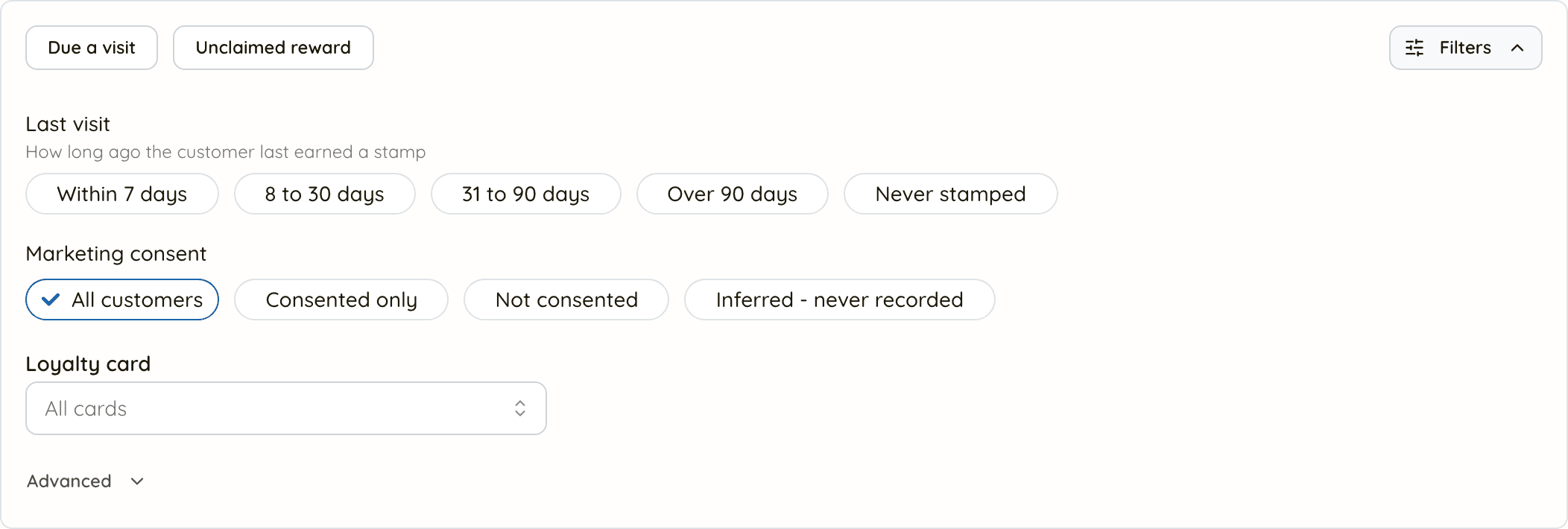
The dashboard shows the same split as a single bar, so you can see the shape of your customer base change month to month. A program that is working moves people up the ladder: the 31-to-90 group shrinks and the within-7-days group grows. A program that is coasting grows only its total.
The two segments that repay attention
People who joined and never got a stamp
Almost always a process problem rather than a customer problem. The usual causes, in order of how often they turn out to be the answer:
- They scanned the QR code at home or from a poster, and have not been in since
- They signed up at the counter, but nobody stamped them while they were standing there
- Staff at one location or one shift are not scanning at all — compare stamps by device
Fix the second one and the number drops immediately. It is the cheapest improvement available to most programs.
People who are owed a reward and have not claimed it
The strongest reason to return that you will ever have: they have already earned something, and you are holding it. The Unclaimed reward preset lists exactly these people, and Scanaroo shows the same thing on the customer's card at the till, so staff can offer it without being asked.
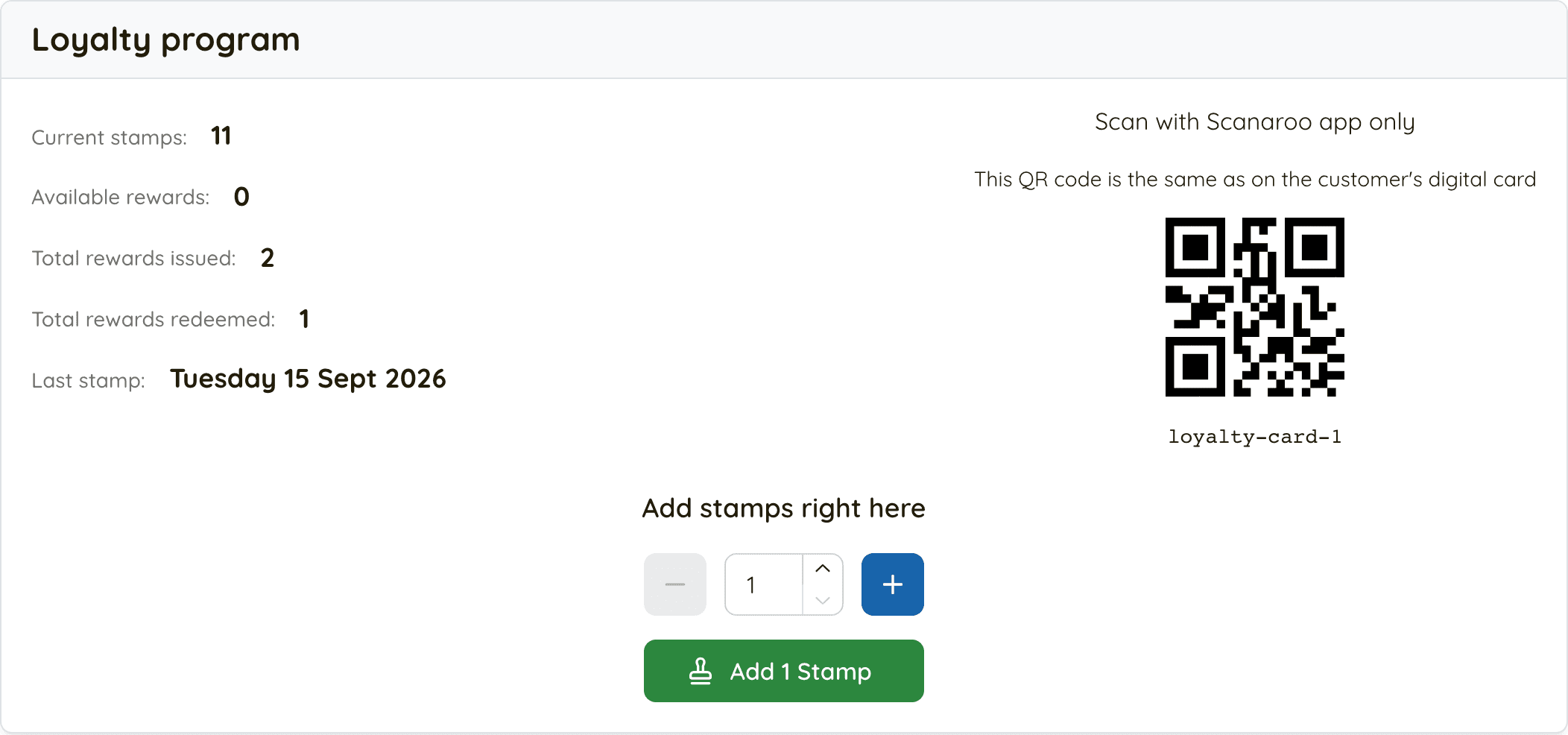
Rewards claimed in front of other customers do double duty. The queue hears it, and it is the single best advertisement your program has.
Things that work at the counter
Engagement work that costs nothing and needs no email tool. These are worth exhausting before anything more elaborate:
- Double-stamp days on your quietest weekday. Moves existing demand into hours you are already paying staff for, which is close to free revenue.
- A bonus stamp for a friend who joins. Both get one. Referral and engagement in a single gesture.
- Use their name. Scanaroo puts it on screen the moment the card is scanned, along with when they were last in. Greeting a regular by name is the cheapest loyalty mechanic there is.
- Say the progress every time. "Two more and that one's on us" is the goal gradient, applied for free, at the exact moment it works.
- Restamp the moment a reward is redeemed. Kivetz found visit rates slow right after a reward is claimed. Starting the next card immediately is the countermeasure.
Two that backfire
- Expiring stamps to create urgency. It reads as a penalty for having been loyal, and it is the complaint regulators hear most about loyalty schemes.
- Discounting so hard the reward stops being special. If there is a promotion every week, the card is no longer the reason anyone comes.
Reaching out between visits
Keeperoo does not send marketing on your behalf. It holds the list, the consent answers and the activity data; you export the segment you want and send from Mailchimp, Klaviyo or whatever you already use. The export guide covers the mechanics.
What makes a between-visits message land
- Send to a segment, not the list. "Due a visit" customers who are three stamps from a reward is a message that writes itself. "Everyone" is a message nobody asked for.
- Lead with what they have, not with what you want. "You're three stamps from a free coffee" outperforms "we miss you" because it is about them and it is true.
- Keep it rare. Irrelevant email is the most cited reason people unsubscribe from loyalty communications. One good message a month beats four ignored ones.
- Give it a deadline that is generous. "This month" is a nudge. "By Friday" is pressure.
Consent first, always
Export with the marketing consent filter set to Consented only. The Spam Act has no small-business exemption, and a customer joining a loyalty card is not by itself consent to marketing. Marketing consent covers what you need.
The card does some of the work for you
A digital card has one advantage a paper one never had: it is on the phone, and it changes. When you add a stamp, the pass in the customer's Apple or Google Wallet updates itself — so the next time they open their wallet to pay for something else entirely, your card is sitting there with a current count on it.
Two things follow. Keep the card's front text current, because it is a small billboard you own. And make sure the reward wording on the card says what people actually get, since that is the version they will read months after they have forgotten anything you said at the counter.
The customer portal
Customers can sign in at keeperoo.au/portal to see their stamps, recover a card onto a new phone, and change whether you may email them. Pointing lapsed customers there is often all it takes — a lost card is a common and entirely invisible reason people stop. More on the portal.
Measuring engagement honestly
Total members only goes up, so it tells you nothing. Four numbers that can go down, and therefore mean something:
Active in the last 30 days, as a share of all members
The single best summary of program health. Track the percentage, not the count — the count rises on signups alone.
Never-stamped, as a share of all members
Your signup-to-first-stamp leak. This one should fall as staff habits improve.
Rewards redeemed versus rewards outstanding
Earning without claiming means the finish line is too far away or too awkward to cross.
Stamps per active customer per month
Visit frequency, in one number. If it is flat while members grow, you are acquiring rather than engaging.
A rhythm that is realistic
- Weekly, two minutes: open the Unclaimed reward list so staff know who to look out for.
- Monthly, fifteen minutes: look at the activity spread against last month, and send one message to the "Due a visit" segment.
- Quarterly: check the reward is still worth what it was worth when you set it, and that the stamp count still matches how often people really come.
Sources and further reading
The Point of Loyalty — For Love or Money™
The annual Australian study of loyalty program members: how many people belong, how many are actually active, and what they say they want. Free executive summary.
Kivetz, Urminsky & Zheng (2006) — The Goal-Gradient Hypothesis Resurrected
Why customers come back faster as a card fills, and why they slow down again straight after claiming a reward.
Nunes & Drèze (2006) — The Endowed Progress Effect
The evidence that a head start you were simply given still makes people finish.
Before any of the email ideas below: the three rules that apply to every commercial message you send.